· Last updated
Attack the stations or save it for the runs? Four HYROX races, one expensive lesson
In my slowest early races I was faster on the sleds and hotter on heart rate — then Wall Balls billed me three-to-one. Mumbai 2026 did not repeat the station trap. Roxzone did the damage instead.
Key findings
- Delhi banked roughly 100 seconds on four strength stations versus Mumbai 2025, then handed back about 360 seconds late — mostly at Wall Balls.
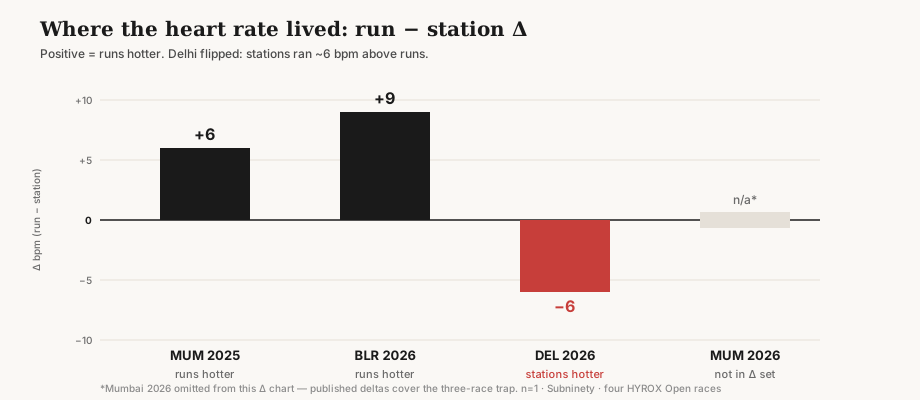
- Heart rate inverted at Delhi: stations ran ~6 bpm hotter than runs. In Mumbai and Bengaluru, runs were the hotter segments.
- Delhi Wall Balls averaged 155.6 bpm at 14:27 — the lowest station HR in the set. That is muscular failure, not a cardio blow-up.
Four HYROX races. Chip splits plus second-level heart rate. The lesson is not “go harder.” It is where you spend the effort.
I have raced HYROX Open four times: Mumbai (Sep 2025), Bengaluru (Apr 2026), Delhi (Jul 2026), Mumbai again (Sep 2026). Official finishes: 1:53:41 → 2:01:06 → 2:08:23 → 2:16:26.
Read only those numbers and the story writes itself: decline. Heart rate and segment data say something sharper.
The three-race trap (still the clearest mechanism)
| Mumbai 2025 | Bengaluru 2026 | Delhi 2026 | |
|---|---|---|---|
| Finish | 1:53:41 | 2:01:06 | 2:08:23 |
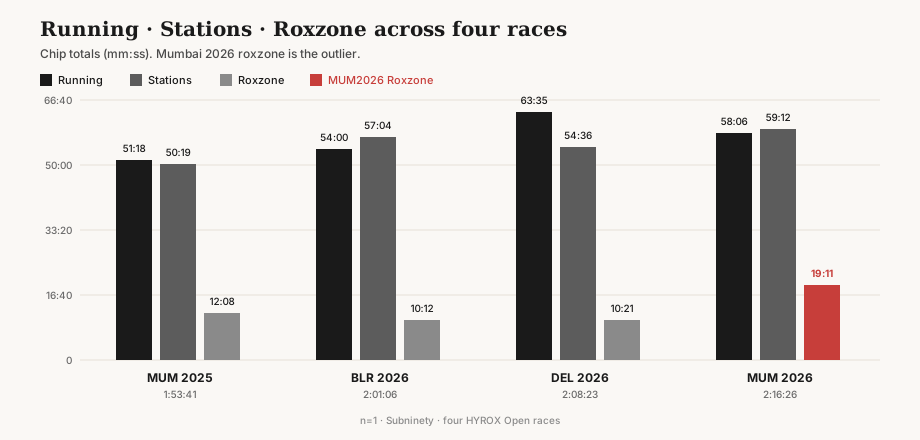
| Running | 51:18 | 54:00 | 63:35 |
| Stations | 50:19 | 57:04 | 54:36 |
| Roxzone | 12:08 | 10:12 | 10:21 |
| Avg HR | 168.5 | 166.3 | 170.1 |
At Delhi I was faster on four strength stations than in my fastest race — including a Sled Push 74 seconds quicker — at heart rates 15–18 bpm higher. I banked about 100 seconds on stations.
I paid about 360 seconds back on the last part of the race. Wall Balls alone went from 9:22 (Mumbai) to 14:27 (Delhi).
Exchange rate: roughly 3.5 seconds returned for every second “gained.”
Heart rate inverted
| Runs (hotter?) | Stations | |
|---|---|---|
| Mumbai 2025 | runs +6 bpm vs stations | controlled |
| Bengaluru 2026 | runs +9 bpm vs stations | controlled |
| Delhi 2026 | stations +6 bpm vs runs | attacked |
Same athlete. Same 16 segments. Opposite effort distribution. Delhi was not fitter. Delhi was borrowing.
The three buckets across all four races — and where heart rate lived in the first three:
What collapse looks like on a watch
Delhi Wall Balls: 14:27 at 155.6 bpm — the lowest station average in the three-race set. If I had been fighting cardiovascularly, HR would have been at the ceiling. It was calm while my legs refused reps. High HR means you are working. Low HR at a slow pace means you already spent the limiter earlier.
Distance correction (Delhi)
Delhi Run 1 was a lap short (300s penalty logged on Run 2). Run 8 was a lap long. Lap-normalised comparable finish is about 2:02:57, not 2:08:23. The real arc after correction is one fast race, then two races ~9 minutes off it — not a straight collapse.
Mumbai 2026 coda: the trap did not repeat
| Mumbai 2026 | |
|---|---|
| Finish | 2:16:26 (adj 2:15:56 after 30s BBJ penalty) |
| Running | 58:06 |
| Stations | 59:12 |
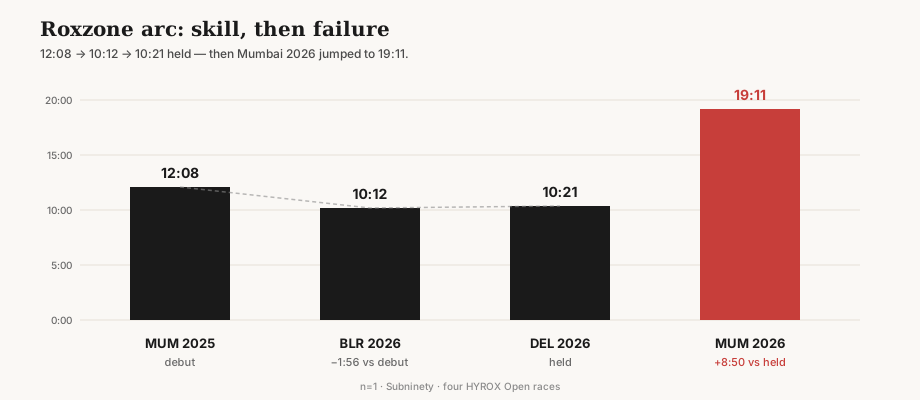
| Roxzone | 19:11 |
| Avg HR | 167.5 |
| Peak HR | 190 |
This race did not look like Delhi’s station attack:
- Sandbag Lunges were my best of four (6:50).
- Sleds were ordinary, not heroic.
- Wall Balls were still terrible (15:43) — but average HR was ~168, not 156. Different failure mode: still working, still grinding.
- The blow-up sat in roxzone: 19:11, including a 5:24 gap after Sandbag Lunges — the largest single transition in the dataset. Placement and what we can (and cannot) claim are in the Mumbai 2026 race report. Cause not yet annotated (queue, stop, bathroom, or data oddity).
Heat context: watch logged about 28.6°C / 78% humidity. Age group moved to 35–39.
What I will defend
- Station aggression has an exchange rate. On my Delhi data the sign is clear even if the exact ratio is one athlete, one day.
- Read Wall Balls with HR, not only the clock. Low HR + slow clock = earlier muscular debt. High HR + slow clock = you are still in the fight (capacity / pacing / heat).
- Roxzone can erase a clean station day. Mumbai 2026 is the proof.
- Sleds are weak fitness signals across venues. Floor friction dominates. Pair them with HR or ignore them for cross-race ego.
What this does not prove
n=1. Three Indian venues, different months, different weather, different training blocks. Bengaluru’s first four segments have weak HR coverage and stay out of HR comparisons. Sled surfaces vary.
If you have raced HYROX twice or more with a watch, the useful experiment is whether the station-attack trap is common — or only how I race.
The named tools and the twenty-minute method live on How to read a HYROX race and Diagnose your last HYROX in 20 minutes.
Data: official HYROX chip splits + Apple Watch time-weighted HR (reference max 195 bpm). Full tables: four-race sheet.
Sources
- HYROX four-race comparison — Prashant Singh