· Last updated
Diagnose your last HYROX in 20 minutes
Finish time is not a diagnosis. In twenty minutes you can split your race into three buckets, read Wall Balls with heart rate, check whether you attacked stations, and flag every long transition.
Key findings
- Never diagnose from finish time alone — split running, stations, and roxzone first.
- Log Wall Balls time AND average HR; slow+low HR and slow+high HR are different failures.
- If early station HR sits clearly above run HR, assume Wall Balls may invoice you.
Finish time is a headline. It is not a diagnosis.
In twenty minutes you can turn chip splits and a heart-rate watch into a usable map of what actually happened — before the race becomes a story you tell yourself. This is the method I use on my own four Open races (1:53:41 → 2:01:06 → 2:08:23 → 2:16:26). Steal the structure. Keep your own numbers.
What you need
- Official chip splits, or reliable segment times for runs 1–8 and stations 1–8
- Average heart rate per segment if your watch logged it (nice-to-have for minutes 5–15; still worth doing buckets without it)
- A notebook or notes app — same-day annotations beat memory
Open the Race OS / start-here page if you want the tool names first. This post is the timer.
Minute 0–5: Build three buckets
Sum three totals:
- Running — runs 1 through 8
- Stations — stations 1 through 8
- Roxzone — everything between: mat exits, queues, kit, the dead air the card calls transitions
Finish ≈ running + stations + roxzone (plus any logged penalties). If your card already prints bucket totals, use those. If not, add by hand once. Do not skip this step to stare at Wall Balls.
Worked example from four races:
| Race | Finish | Running | Stations | Roxzone |
|---|---|---|---|---|
| Mumbai 2025 | 1:53:41 | 51:18 | 50:19 | 12:08 |
| Bengaluru 2026 | 2:01:06 | 54:00 | 57:04 | 10:12 |
| Delhi 2026 | 2:08:23 | 63:35 | 54:36 | 10:21 |
| Mumbai 2026 | 2:16:26 | 58:06 | 59:12 | 19:11 |
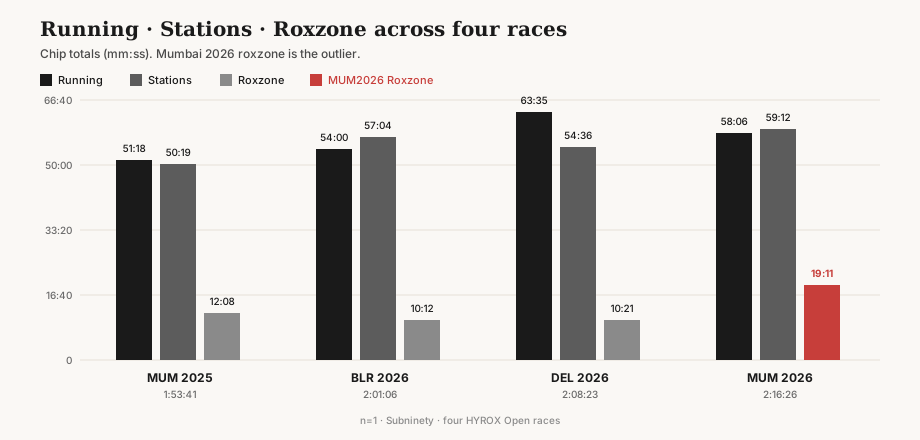
Read only finishes and you get “decline.” Read buckets and you get three different races: Delhi’s running/stations trade, Mumbai 2026’s roxzone explosion, and a pair of mid races where roxzone was the only durable win.
Delhi footnote: lap math (Run 1 short, Run 8 long) puts a comparable finish near 2:02:57, not 2:08:23. Mumbai 2026: 30s BBJ penalty → adjusted ~2:15:56. Corrections matter; inventing causes for them does not.
Output of this block: three numbers and a one-line note on which bucket dominates the change versus your last race.
Minute 5–10: Wall Balls diagnostic
Log two values for Wall Balls: time and average HR.
My set:
| Race | Wall Balls | Avg HR |
|---|---|---|
| Mumbai 2025 | 9:22 | 163.4 |
| Bengaluru 2026 | 11:28 | 159.9 |
| Delhi 2026 | 14:27 | 155.6 |
| Mumbai 2026 | 15:43 | ~168 |
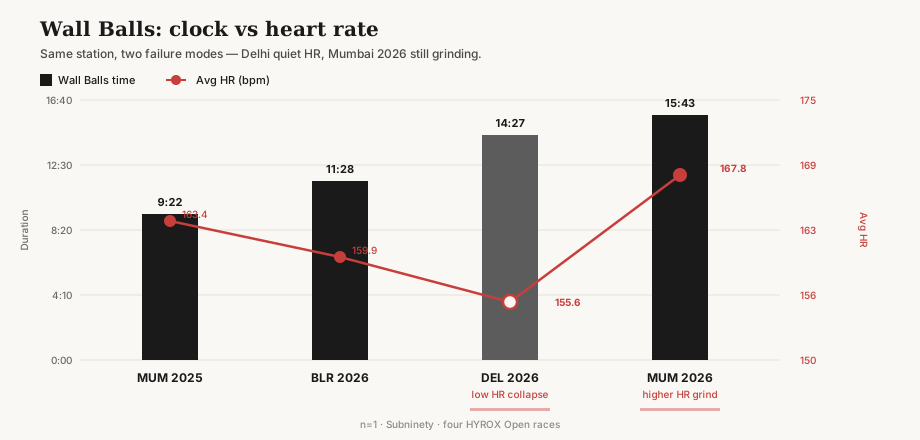
Two failure modes, same station:
- Mode A — slow clock + unusually low HR (Delhi 14:27 @ 155.6). Legs already spent. Muscular debt from earlier stations. Not “I need more easy miles.”
- Mode B — slow clock + preserved working HR (Mumbai 2026 15:43 @ ~168). Still fighting. Capacity under fatigue, heat, total time on feet, or simply a longer day — different prescription than Mode A.
One number without the other is half a diagnosis. If your watch did not capture Wall Balls HR, still log the clock and mark HR as missing — do not fill the gap with vibes.
Full mechanism: What a Wall Balls collapse actually looks like.
Output of this block: Mode A, Mode B, or “too fast / on baseline to classify” — plus whether HR data is present.
Minute 10–15: Station exchange / HR polarity
Compare average HR on stations to average HR on runs for the same race.
On my data:
| Race | Polarity |
|---|---|
| Mumbai 2025 | runs +6 bpm vs stations |
| Bengaluru 2026 | runs +9 bpm vs stations |
| Delhi 2026 | stations +6 bpm vs runs |
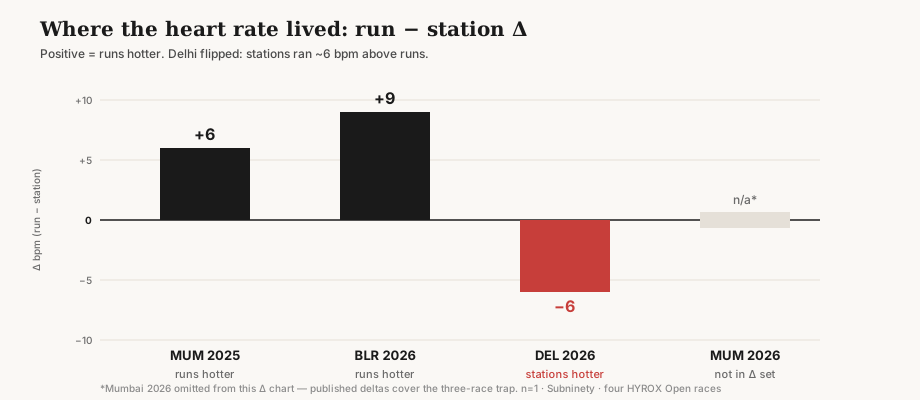
Delhi banked ~100 seconds on four strength stations versus Mumbai 2025 and paid ~360 seconds late (≈ 3.5×), mostly at Wall Balls. Station HR was hotter than run HR that day — inverted from the first two races. That is what “attacking stations” looked like on a watch, not on Instagram.
Rule of thumb I take forward: if early station HR sits clearly above your run HR and feels like borrowing, assume Wall Balls may invoice you. Your exact ratio will differ. Measure across two+ races before you trust a slogan.
Mumbai 2026 did not repeat the station-attack pattern — lunges were a PB — so this block can come back clean while another bucket is on fire. That is the point of running all four tools.
Deeper cut: Attack the stations or save it for the runs?.
Output of this block: “stations hotter,” “runs hotter,” or “roughly matched” — and whether early strength felt like a loan.
Minute 15–20: Roxzone audit
List every transition you can see on the card. Flag any gap over about 90 seconds. Write one same-day note for each flag: queue, belt, bathroom, confusion, photo, nothing memorable. A hole without a note becomes fiction in a month.
My roxzone arc: 12:08 → 10:12 → 10:21 → 19:11.
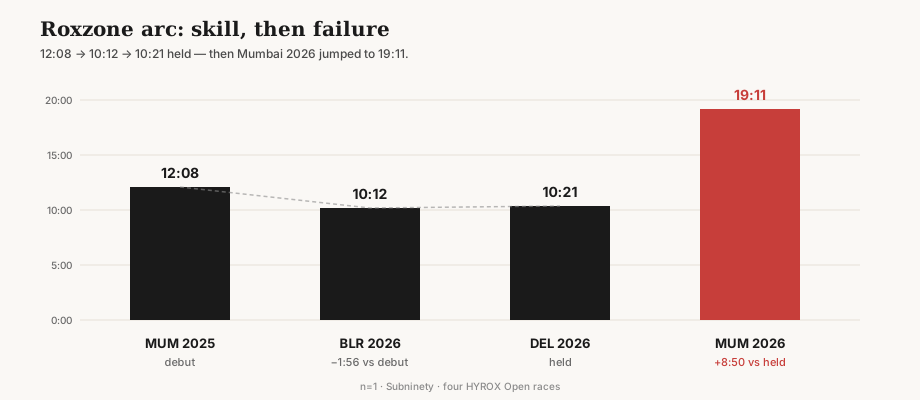
Mumbai 2026 is the cautionary example. Total roxzone 19:11. Inside it: a 5:24 gap after Sandbag Lunges — largest transition in the dataset. Lunges themselves were a PB 6:50. Run 8 after the gap was the fastest closing run of four. The slow thing is the interval between them.
Cause of that gap is not established. Queue, stop, bathroom, confusion, or logging oddity would all print the same number. Do not moralise it. Do annotate next time. Placement and what we can claim: Mumbai 2026 — the 5:24 gap. Skill framing: Roxzone is a skill.
Output of this block: total roxzone, a short list of >90s gaps, and same-day notes (or an honest “unannotated”).
What to change next race
Use the four outputs as a decision tree — not a personality quiz:
- Mode A Wall Balls → protect early strength. Write HR/RPE caps for sleds and lunges before the gun. The bill arrives at the last station.
- Mode B Wall Balls → capacity under fatigue / heat / total load. High-rep Wall Balls under fatigue; scrub leaks elsewhere; do not assume “more sled intensity” is the fix.
- Roxzone dominates the regression → treat transitions as a skill with a race goal (I use sub-11:00 total as a process target). Rehearse mat exits when HR is already elevated.
- Buckets balanced but everything slow → fitness / training-block problem, not a pacing slogan. Train the engine; stop rearranging deck chairs on the card.
- Stations hotter than runs + Mode A → you likely paid an exchange rate. Measure it next race before you declare a philosophy.
Worksheet for race day: HYROX pacing checklist. Named tools without the timer: How to read a HYROX race.
What this method does not prove
n=1. Indian venues. Apple Watch optical HR. Bengaluru’s early segments have weak HR coverage and stay out of polarity comparisons where sparse. Sled floors vary by venue. Absolute times are mine; the structure of the diagnosis is what is meant to travel.
If you have raced twice or more with a watch, the useful experiment is whether these signatures show up in your data — not whether my 3.5× Delhi rate is universal.
Data: official HYROX chip splits + Apple Watch time-weighted HR. Full tables: four-race sheet.
Sources
- HYROX four-race comparison — Prashant Singh