Why finish time alone lies
A finish time collapses three different races into one number: how you ran, how you worked the stations, and how you moved between them. Two athletes can print the same clock and need opposite training. Split the day into three buckets before you invent a story.
Tool 1 — Three-bucket read
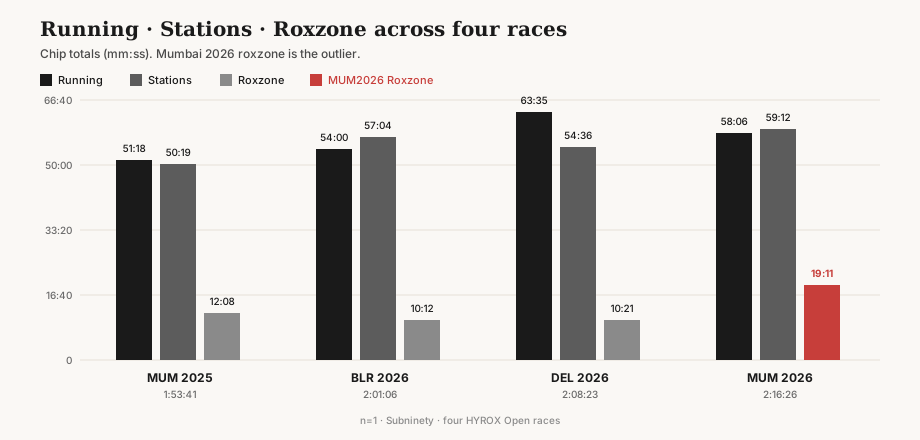
Sum runs 1–8, stations 1–8, and everything between (roxzone). That is the first honest map of the race.
| Race | Finish | Running | Stations | Roxzone |
|---|---|---|---|---|
| Mumbai 2025 | 1:53:41 | 51:18 | 50:19 | 12:08 |
| Bengaluru 2026 | 2:01:06 | 54:00 | 57:04 | 10:12 |
| Delhi 2026 | 2:08:23 | 63:35 | 54:36 | 10:21 |
| Mumbai 2026 | 2:16:26 | 58:06 | 59:12 | 19:11 |
Delhi note: lap-corrected comparable finish is about 2:02:57(Run 1 short, Run 8 long). Mumbai 2026: 30s Burpee Broad Jump penalty → adjusted about 2:15:56.
Deeper read:Attack the stations or save it for the runs?
Tool 2 — Station exchange rate
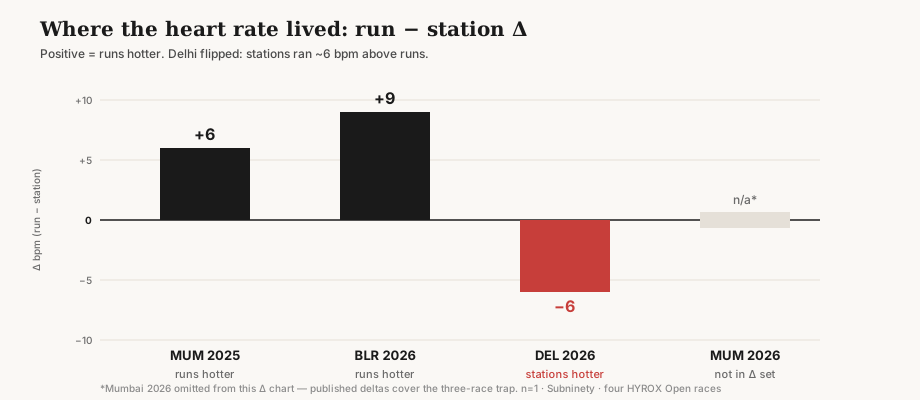
At Delhi I banked roughly 100 seconds on four strength stations versus Mumbai 2025, then paid about 360 secondslate — mostly at Wall Balls. Exchange rate ≈ 3.5×.
Heart rate inverted: stations ran ~6 bpm hotter than runs at Delhi. In Mumbai 2025 and Bengaluru the opposite held — runs were the hotter segments. Same athlete, opposite effort distribution. Delhi was borrowing.
Full mechanism:Attack the stations or save it for the runs?
Tool 3 — Wall Balls diagnostic
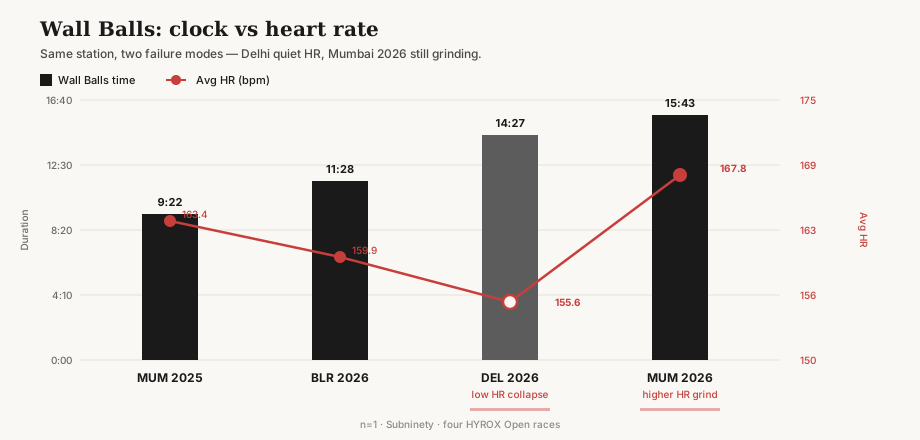
Wall Balls across the four: 9:22 → 11:28 → 14:27 → 15:43. The clock alone is demoralising. Time + average HR is a diagnosis.
- Mode A — slow + low HR: Delhi 14:27 @ 155.6 bpm. Calm heart, spent legs. Muscular debt set earlier.
- Mode B — slow + working HR: Mumbai 2026 15:43 @ ~168 bpm. Still grinding. Capacity, heat, or total load — not the same fix as Mode A.
Full write-up:What a Wall Balls collapse actually looks like
Tool 4 — Roxzone as a skill
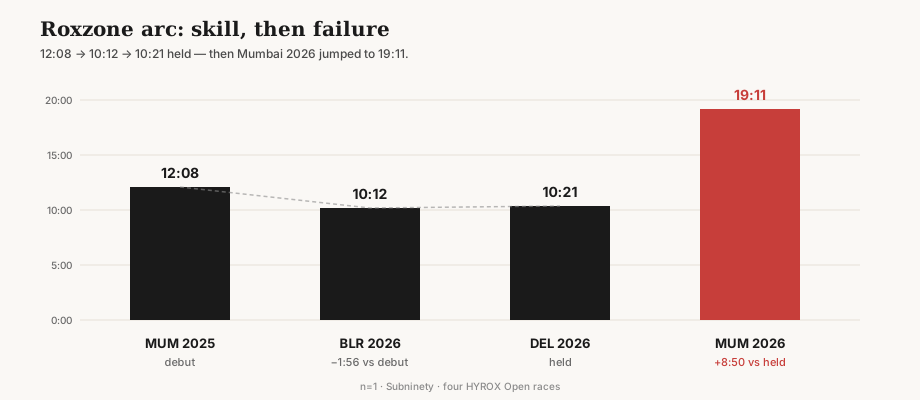
Roxzone arc: 12:08 → 10:12 → 10:21 → 19:11. It was the only durable improvement across the first three races — then the biggest single loss.
Mumbai 2026: Sandbag Lunges were a PB (6:50). The race still sank in a 19:11 roxzone, including a5:24 gap after lunges — the largest transition in the set. Cause not established (queue, stop, bathroom, confusion, or logging). Do not invent one.
Roxzone is a skill·Mumbai 2026 — the 5:24 gap
How to use this OS
- Get official chip splits (or reliable segment times) and watch average HR per segment if you have it.
- Build the three buckets: running, stations, roxzone.
- Log Wall Balls time and average HR — Mode A vs Mode B.
- Check station average HR versus run average HR. If stations sit clearly hotter early, assume Wall Balls may invoice you.
- Annotate every transition gap over ~90 seconds the same day.
- Run the full20-minute self-diagnosiswhile the race is still fresh.
- Analyze your own race:upload Apple Health + your result card in the freeHYROX race insights toolto see HR at every station and running lap.
Evidence & honesty
n=1. Indian venues. Apple Watch optical HR. Absolute numbers are mine; the direction of the signals is what travels. Full tables:four-race sheet.
Race-day worksheet:HYROX pacing checklist·About
Read next
- Analyze your own race — HYROX race insights tool
- Diagnose your last HYROX in 20 minutes
- Attack the stations or save it for the runs?
- What a Wall Balls collapse actually looks like
- Roxzone is a skill
- Mumbai 2026 race report
- How many calories does a HYROX burn?
- HYROX pacing checklist
- Classic analyses:Bengaluru 2026 heart rate,Bengaluru calories (1,441 kcal),Method
Honesty line: one athlete, Indian venues, Apple Watch optical HR. Direction of the signals is what travels; absolute numbers are mine.